 VapeWholesaleHub
Nicotine Free Customer Education That Reduces Complaints — Retail Chains
The price difference between two nicotine free quotes is often smaller than the cost of one failed shipment. This overview is written for buyers who would rather understand the failure modes up front than discover them after customs clearance.
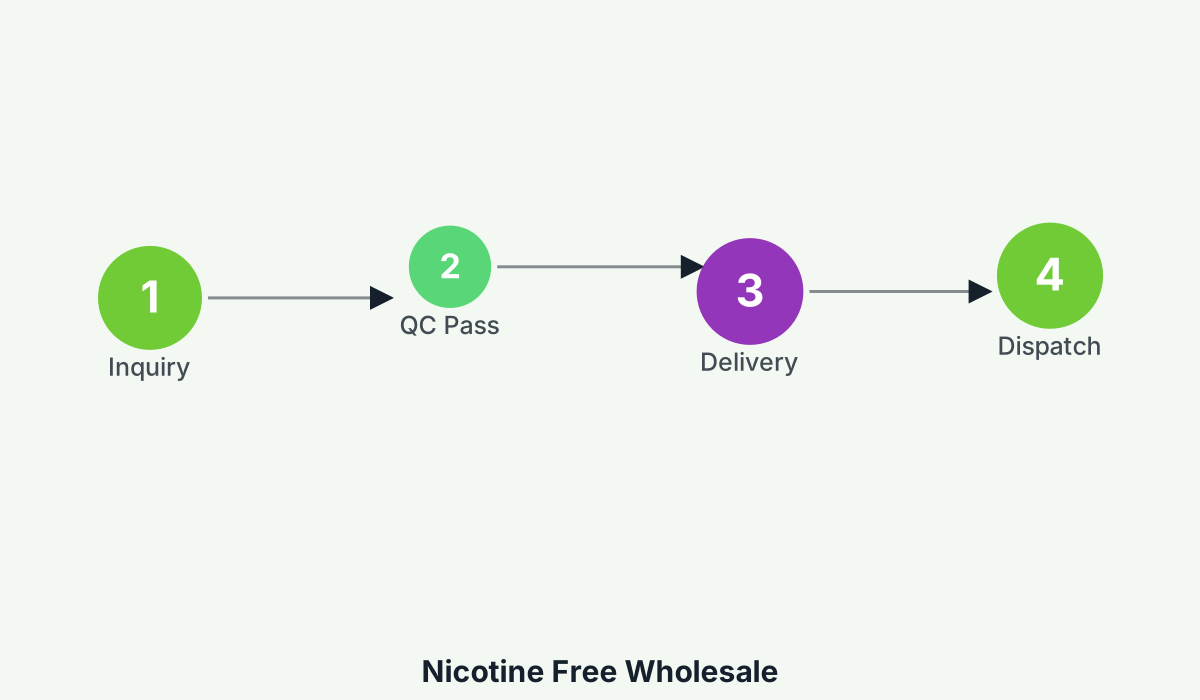
Inspection Before Dispatch
Most defects in nicotine free are not dramatic. They are loose tolerances, a slightly thin seal, a mouthpiece that clicks. Left alone they turn into leak complaints, which are the single most common reason a retailer drops a line.
Incoming inspection for nicotine free is not about opening boxes at random. We weigh a sample of cartons, check batch codes against the production record, run a draw resistance measurement, and log the results so that a complaint three months later can be traced to a specific run.
- Write the complaint threshold into the order terms.
- Rotate stock by batch code rather than by delivery date.
- Start with a mixed carton and let your own sell-through decide.
- Agree the tolerance band in writing before approving artwork.
- Ask how the factory measures puff count, then compare like with like.
How Nicotine Free Fits the Assortment
Nicotine Free sits at an interesting point in the assortment. It is familiar enough to be an impulse purchase and specific enough to build a repeat pattern around. Treating it as either pure commodity or pure specialty both lead to poor results.
Selling Nicotine Free at Store Level
Use your nicotine free staff training time on the two questions customers actually ask. Anything more detailed gets forgotten by the second shift.
Staff knowledge moves nicotine free more than any fixture. A two minute explanation of the difference between this line and the one next to it converts a browsing shopper into a repeat buyer far more reliably than a discount.
What to Fix Before Approving Nicotine Free
A written nicotine free specification should be short enough to read in a minute and precise enough to argue about. If a factory cannot confirm a number in writing, assume the number is whatever is cheapest that week.
Revisit the nicotine free specification after every third order. Small improvements compound, and factories take a buyer more seriously when the document has clearly been used.
| Product category | Refillable kit |
|---|---|
| Resistance band | 1.2 - 1.4 ohm |
| Capacity tolerance | +/- 3% |
| Puff count method | Machine cycle 2s on / 18s off |
| Master carton | 400 units |
| Carton weight | 4.5 kg |
| Shelf life | 24 months |
| Storage | 15-25 C, dry, away from direct light |
Modelling a Healthy Margin
Compare nicotine free quotes on the same incoterm. A price that looks better because it excludes a cost you assumed was included is not a saving at all.
Discounting nicotine free to win shelf space tends to reset customer expectations permanently. Volume support in kind, such as display material, usually costs less in the long run.
Indicative reference points for planning purposes: entry tier from USD 2.07 per unit at 2000 units, mid tier at USD 1.60, and volume tier at USD 0.66 for full container quantities. These figures move with specification, packaging and freight, so treat them as a shape rather than a quote.
Freight, Customs and Timing
Consolidating nicotine free with other lines is often the biggest single saving available to a mid size importer. The unit cost does not change but the landed cost does, sometimes materially.
Model nicotine free freight both ways before choosing a method: cost per unit and cost per week of delay. The second figure is the one that decides whether a cheap option was actually cheap.
Practical Checklist
- Start with a mixed carton and let your own sell-through decide.
- Check carton dimensions against your freight quote before confirming.
- Confirm the current customs classification with your own broker.
- Ask how the factory measures puff count, then compare like with like.
- Model landed cost, not ex-works price, when comparing quotes.
- Plan the switch from air to sea freight before you need it.
Frequently Asked Questions
Can you match an existing product I already sell?
Often yes, provided we can measure it properly. Send a physical sample and we will report back on what can be matched, what will differ slightly, and why. An honest gap is more useful than a vague promise.
What information do you need to quote?
Target specification, approximate quantity, destination and any packaging requirement. With those four we can usually come back with a costed option the same working day rather than a request for more information.
What if I only need a small first order?
That is normal and sensible. A mixed carton lets you test nicotine free in your own market before committing to a production run, and the specification you approve at that stage carries through to larger orders unchanged.
Is there support for in-store material?
Yes. Shelf talkers, counter cards and simple planogram suggestions are available for nicotine free ranges that reach a sensible volume. Most retailers find the plain strength and flavour cards do the most work.
Is there a warranty on nicotine free?
Manufacturing defects are covered against the retained sample standard. Normal wear, misuse and damage after opening are not. We publish the threshold in the order terms so both sides know exactly what the claim process looks like.
Next Step
Questions that are not answered here are usually the interesting ones. Reach out with the specifics of your market and we will answer with numbers rather than adjectives.
Related Reading
- Nicotine Free Sample Approval Meeting Agenda — 2026 Buyer Notes
- Nicotine Free Packaging Waste and Recycling Options — Real Numbers Only
- Nicotine Free Storage Life Extension Through Better Handling — a Factory Floor View
- Nicotine Free vs Standard Alternatives: What Changes for Your Shelf — a Factory Floor View
- Nicotine Free Warranty Claims Workflow — Mixed Cabinets
- Nicotine Free First Order Playbook for New Importers — Busy Buyers