 VapeWholesaleHub
Nicotine Free Artwork and Dieline Essentials — Landed Cost Worked Through
Buyers often ask us to explain why two nicotine free samples that look identical behave differently after a month. The answer is almost always tolerance control, and it is more interesting than it sounds.
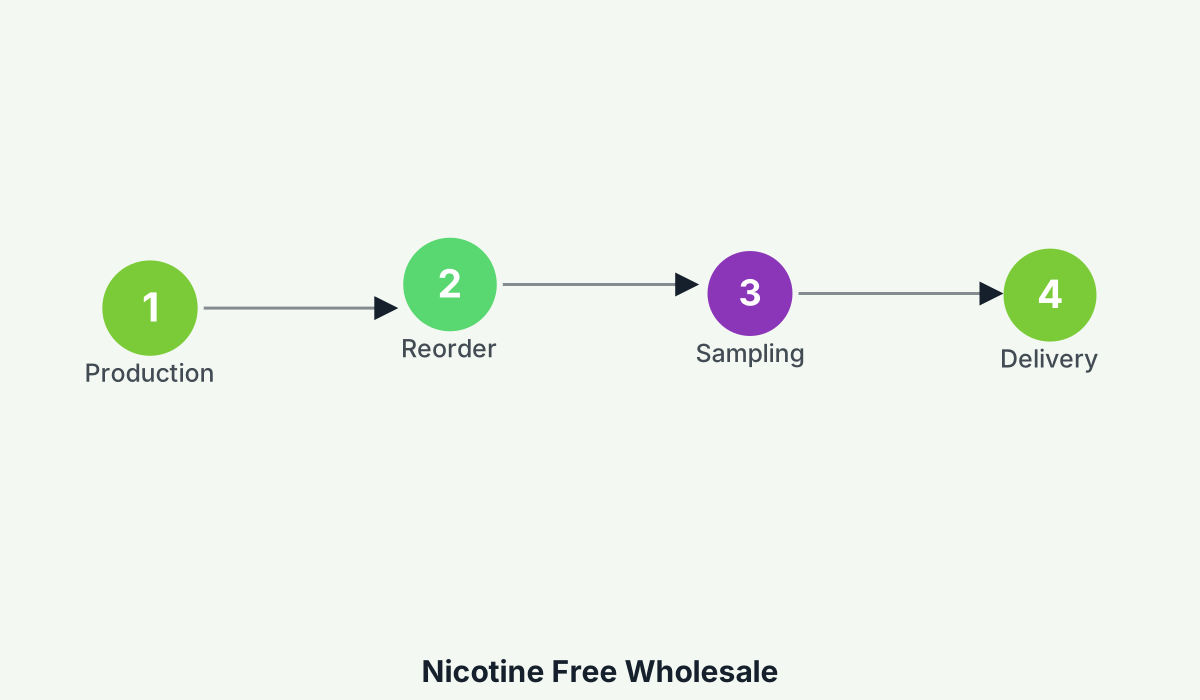
Freight, Customs and Timing
Carton dimensions for nicotine free are a design decision, not a packing afterthought. A few centimetres on the master carton can change how many units fit a pallet, and that repeats on every order.
Freight is the hidden half of nicotine free unit economics. A denser master carton can save more per unit than a hard negotiation on factory price, because the saving repeats on every reorder rather than once.
Inspection Before Dispatch
AQL sampling gets a lot of attention, but for nicotine free the more useful habit is simply measuring the same three things on every single batch. Trend lines catch problems that pass/fail checks miss.
Keep a photo record of every nicotine free approval sample. Written descriptions age badly; a dated photograph next to a delivered unit settles most arguments in seconds.
- Plan the switch from air to sea freight before you need it.
- Agree the tolerance band in writing before approving artwork.
- Start with a mixed carton and let your own sell-through decide.
- Write the complaint threshold into the order terms.
- Ask how the factory measures puff count, then compare like with like.
Positioning Nicotine Free on Your Shelf
Think about where nicotine free sits in your customer's week. If it is a weekly restock, breadth matters less than availability. If it is an occasional treat, flavour range and display story carry more weight.
What to Fix Before Approving Nicotine Free
Ask any factory for the same nicotine free sample twice, three months apart. If the second sample drifts, the production line is running without statistical control and your reviews will drift with it. Consistency over time is a more useful signal than a single good sample.
Specification sheets are where a nicotine free deal is won or quietly lost. Two samples can look and taste the same while using different coil wire, different wicking density and different tolerances on the mouthpiece. Those details decide how the unit behaves in week three rather than minute three.
| Product category | Open system |
|---|---|
| Resistance band | 1.2 - 1.4 ohm |
| Capacity tolerance | +/- 3% |
| Puff count method | Machine cycle 3s on / 27s off |
| Master carton | 240 units |
| Carton weight | 8.9 kg |
| Shelf life | 18 months |
| Storage | 15-25 C, dry, away from direct light |
Modelling a Healthy Margin
Watch the nicotine free price you pay over a year rather than per order. Factories respond well to visible volume, and a quarterly review is usually worth more than a hard negotiation each time.
Indicative reference points for planning purposes: entry tier from USD 1.35 per unit at 500 units, mid tier at USD 1.11, and volume tier at USD 0.98 for full container quantities. These figures move with specification, packaging and freight, so treat them as a shape rather than a quote.
Practical Checklist
- Rotate stock by batch code rather than by delivery date.
- Model landed cost, not ex-works price, when comparing quotes.
- Write the complaint threshold into the order terms.
- Start with a mixed carton and let your own sell-through decide.
- Agree the tolerance band in writing before approving artwork.
- Ask how the factory measures puff count, then compare like with like.
Frequently Asked Questions
What happens if my market changes its rules?
Regulations move, and packaging or documentation sometimes has to follow. We keep approved artwork files on hand so that a required change is a reprint rather than a redesign, which keeps the cost and delay down.
Is there support for in-store material?
Yes. Shelf talkers, counter cards and simple planogram suggestions are available for nicotine free ranges that reach a sensible volume. Most retailers find the plain strength and flavour cards do the most work.
What if a batch does not match the sample?
Keep the retained samples from the approval stage. If a delivered batch measurably differs, we compare against the retained set and resolve it against the production record. This is why we insist on sealed retained units from every run.
How should nicotine free be stored?
Cool, dry and out of direct sunlight. Heat and light are the two things that shorten shelf life fastest. Rotate stock by batch code rather than by arrival date, and keep cartons off concrete floors in humid warehouses.
How long does a nicotine free order take to arrive?
Production typically takes ten to eighteen working days after artwork approval, and transit depends on the method you choose. Air express is fastest, sea freight is cheapest at volume. We confirm both at quotation so there is no surprise later.
Next Step
Nobody wins when a first order is too large to learn from. Start with a mixed carton, check how it moves in your own market, then scale the lines that earned the shelf space.
Related Reading
- Nicotine Free Approval Workflow From Sample to Shipment — EU Markets
- Nicotine Free Reading Factory Capacity Honestly — EU Markets
- Nicotine Free Warranty Claims Workflow — Landed Cost Worked Through
- Nicotine Free Order Consolidation Across Suppliers — Warehouse Teams
- Spotting Defects in Nicotine Free Before Shipment — Latin America
- Nicotine Free Warranty Claims Workflow — Busy Buyers