 VapeWholesaleHub
Comparing Nicotine Free Factory Tiers and What You Get — Established Chains
This page is written for the person who has to sign the purchase order, not for the person who designed the packaging. If you are weighing up nicotine free right now, the sections below follow the order in which the real decisions tend to arrive.

Getting Nicotine Free to Your Warehouse
Air freight makes sense for a first nicotine free order when you need to test demand quickly, but almost every steady programme moves to sea freight once volumes stabilise. Planning that switch early avoids a painful margin squeeze later.
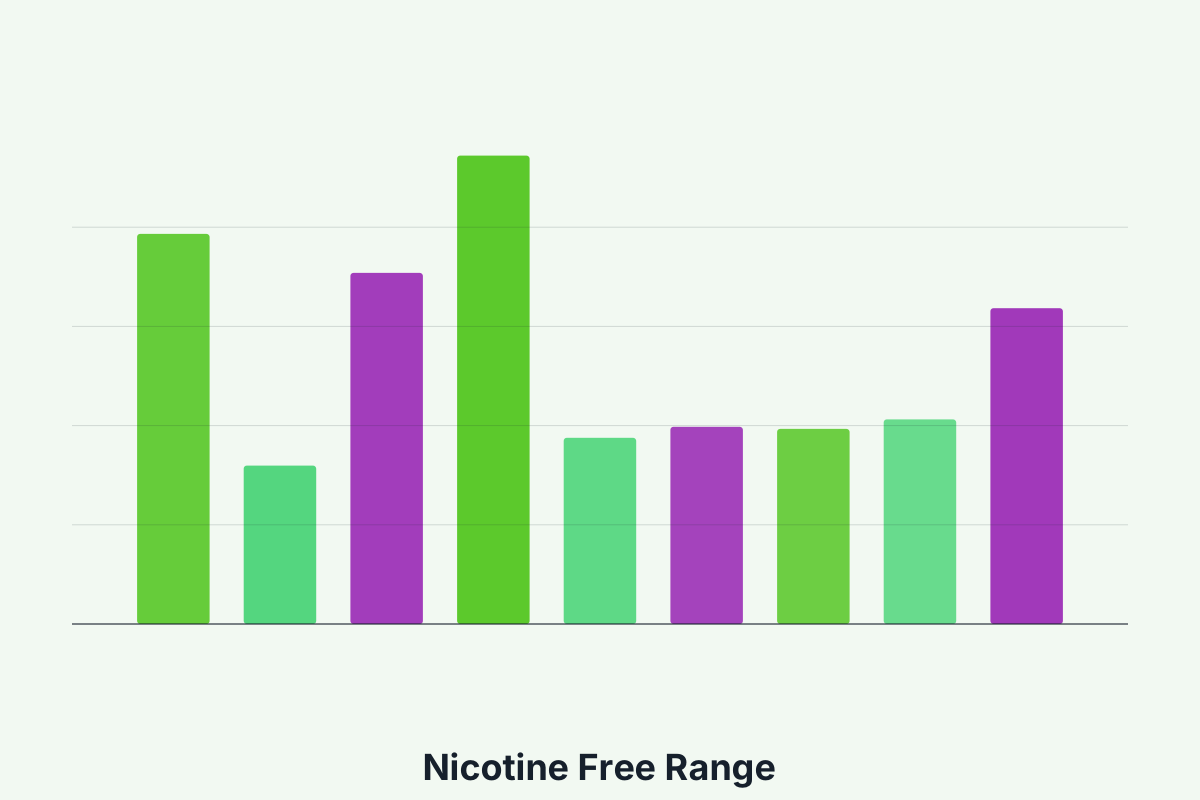
Market Signals
Expect nicotine free packaging requirements to keep tightening. Designs that leave room for additional labelling age better than tight layouts that need a full reprint to comply.
One shift worth planning for: shorter nicotine free reorder cycles with smaller average drops. It favours suppliers with flexible production slots over those who only want large annual commitments.
Quality Control in Practice
Train whoever receives nicotine free cartons to note anything unusual at the point of unloading. Damage discovered at the dock is a freight claim; damage discovered a week later is your problem.
Incoming inspection for nicotine free is not about opening boxes at random. We weigh a sample of cartons, check batch codes against the production record, run a draw resistance measurement, and log the results so that a complaint three months later can be traced to a specific run.
- Ask how the factory measures puff count, then compare like with like.
- Check carton dimensions against your freight quote before confirming.
- Start with a mixed carton and let your own sell-through decide.
- Keep sealed retained samples from every production batch.
- Agree the tolerance band in writing before approving artwork.
Positioning Nicotine Free on Your Shelf
One useful exercise: list every nicotine free line you stock and mark the last date each one sold at full price. Anything without a recent full price sale is taking space from something that would use it better.
Category planning for nicotine free works best when you map it against three shopper types: the restocker who already knows what they want, the switcher who wants something stronger, and the explorer who buys on flavour name alone.
The Specification That Matters
When we write a nicotine free specification with a distributor, we fix four things first: the resistance band, the liquid capacity tolerance, the puff count methodology and the packaging master carton. Everything else can flex without changing the customer experience.
| Product category | Disposable |
|---|---|
| Resistance band | 0.8 - 1.0 ohm |
| Capacity tolerance | +/- 5% |
| Puff count method | Declared by capacity |
| Master carton | 400 units |
| Carton weight | 4.8 kg |
| Shelf life | 12 months |
| Storage | 15-25 C, dry, away from direct light |
Turning Nicotine Free Into Repeats
On shelf, nicotine free sells on clarity. A plain shelf talker that states strength and flavour in two words outperforms a beautifully designed but vague display, because most purchase decisions here take under ten seconds.
Staff knowledge moves nicotine free more than any fixture. A two minute explanation of the difference between this line and the one next to it converts a browsing shopper into a repeat buyer far more reliably than a discount.
Practical Checklist
- Rotate stock by batch code rather than by delivery date.
- Agree the tolerance band in writing before approving artwork.
- Check carton dimensions against your freight quote before confirming.
- Model landed cost, not ex-works price, when comparing quotes.
- Ask how the factory measures puff count, then compare like with like.
- Start with a mixed carton and let your own sell-through decide.
Frequently Asked Questions
Can you match an existing product I already sell?
Often yes, provided we can measure it properly. Send a physical sample and we will report back on what can be matched, what will differ slightly, and why. An honest gap is more useful than a vague promise.
How are price changes handled on repeat orders?
{K} pricing is reviewed against input costs and volume rather than adjusted casually. Any change is confirmed in writing before the next order is scheduled, with the reason stated so you can judge it yourself.
What if I only need a small first order?
That is normal and sensible. A mixed carton lets you test nicotine free in your own market before committing to a production run, and the specification you approve at that stage carries through to larger orders unchanged.
What is the usual minimum order for nicotine free?
For a standard production run the minimum is normally one master carton per flavour, though mixed cartons can be arranged for a first order. If you are testing the line, ask about a sample pack first and treat the freight as part of your research budget.
Can I mix strengths in one order?
In most cases yes, as long as each strength meets the minimum run length. Mixed strength cartons are popular with retailers building their first display because they show the full ladder without over committing.
Next Step
Questions that are not answered here are usually the interesting ones. Reach out with the specifics of your market and we will answer with numbers rather than adjectives.
Related Reading
- How to Read a Nicotine Free Certificate of Analysis — Three Price Tiers
- Seasonal Planning for Nicotine Free Inventory — Before Your Next Order
- Nicotine Free Handling Product Recalls Professionally — Cross-Border Trade
- Nicotine Free Nicotine Strength Selection for Mixed Cabinets — Low Minimum Quantities
- Nicotine Free Slow Moving Stock and Remedial Actions — Convenience Retail
- Nicotine Free Currency and Payment Risk Basics — EU Markets